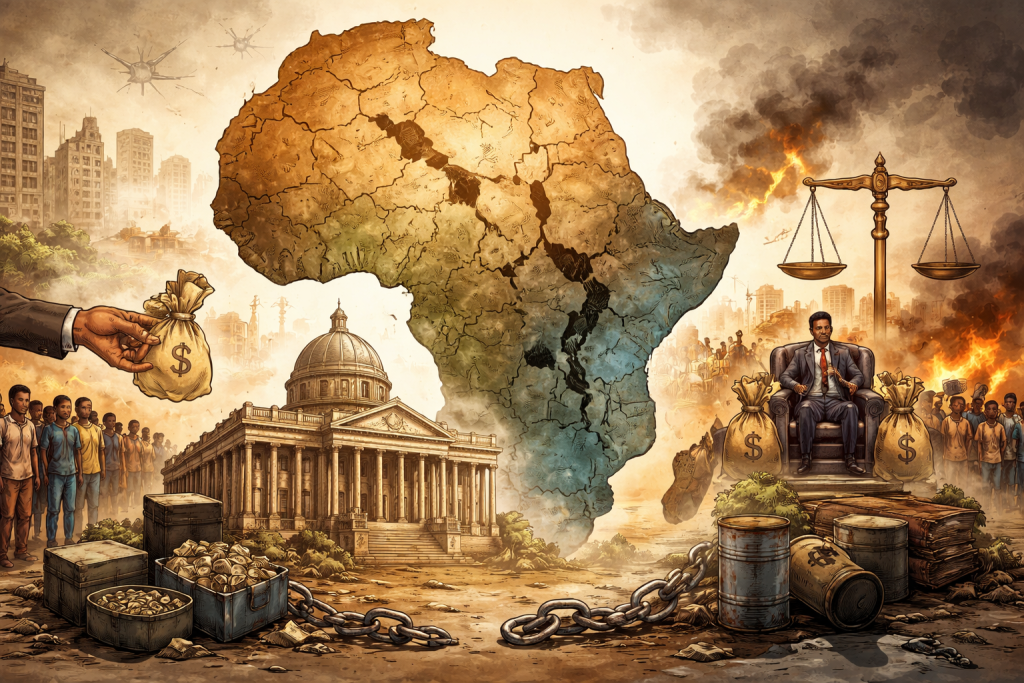

Africa is a continent rich in natural resources, cultural diversity, and human potential. Yet many African countries continue to face serious governance challenges. Political instability, weak institutions, corruption, and inconsistent economic policies have limited the ability of governments to create stable and prosperous societies. While the causes of these governance problems are complex and historically rooted, several structural factors consistently appear across many African states.
Understanding these factors is essential not only for analyzing Africa’s current political and economic landscape, but also for identifying sustainable solutions that can help build stronger and more stable governance systems in the future.
Weak Institutional Structures
One of the most fundamental governance challenges in many African countries is the weakness of state institutions. Effective governance requires institutions that are stable, predictable, and independent. These institutions include courts, civil services, regulatory agencies, and oversight bodies that ensure accountability within government systems.
In many African states, however, institutions are often heavily dependent on political leadership rather than functioning as independent structures. When institutions are weak or overly centralized around individuals, policies can change dramatically with each new administration. This creates instability and discourages long-term planning.
Strong institutions provide continuity regardless of who holds political power. Countries with durable institutional frameworks are able to implement long-term economic policies, maintain rule of law, and protect public resources from misuse. Without these institutional safeguards, governance becomes highly vulnerable to political fluctuations and personal interests.
The Impact of Corruption and Patronage Systems
Another major obstacle to effective governance in many African countries is the persistence of corruption and patronage networks. Patronage systems often reward loyalty rather than competence, which weakens public administration and reduces efficiency in government operations.
When appointments in government institutions are based on personal connections, political loyalty, or ethnic alliances instead of professional qualifications, the overall quality of governance declines. Public institutions become less capable of delivering essential services such as education, healthcare, infrastructure, and economic regulation.
Corruption also damages public trust. Citizens who perceive that state resources are misused or distributed unfairly may lose confidence in government institutions. This erosion of trust can create a cycle in which citizens disengage from political processes, further weakening accountability mechanisms.
Reducing corruption requires transparent institutions, independent oversight mechanisms, and governance systems that prioritize merit and competence in public administration.
Historical and Structural Challenges
The governance challenges faced by many African countries cannot be fully understood without considering historical and structural factors. Colonial administrative systems often prioritized resource extraction rather than institution-building. As a result, many newly independent states inherited governance structures that were not designed to support long-term political stability or inclusive economic development.
In addition, rapid population growth, economic inequality, and regional conflicts have placed enormous pressure on government systems across the continent. These structural challenges make governance reform more complex and require comprehensive institutional solutions rather than short-term political fixes.
Many African leaders and policy thinkers increasingly recognize that sustainable development depends on improving governance frameworks. This includes strengthening institutions, promoting accountability, and developing administrative systems capable of managing modern economic and social demands.
Conclusion: The Need for Institutional Reform
The governance challenges faced by many African countries are not the result of a lack of resources or potential. Rather, they are largely connected to institutional weaknesses, corruption, and historical structural constraints. Addressing these challenges requires a long-term commitment to building strong institutions that operate independently of political personalities.
Institutional reform, merit-based public administration, and transparent governance systems can play a critical role in transforming governance across the continent. By focusing on institutional stability and professional governance structures, African states can create the foundation for sustainable development, political stability, and economic growth.
Ultimately, the future of governance in Africa will depend not only on political leadership but also on the ability to build institutions that serve the public interest and operate according to principles of competence, accountability, and merit.
Sources:
World Bank – Governance and Development
Mo Ibrahim Foundation – Ibrahim Index of African Governance
Transparency International – Corruption Perceptions Index
Acemoglu & Robinson – Why Nations Fail (Institutional Theory)